Discovery · Connect
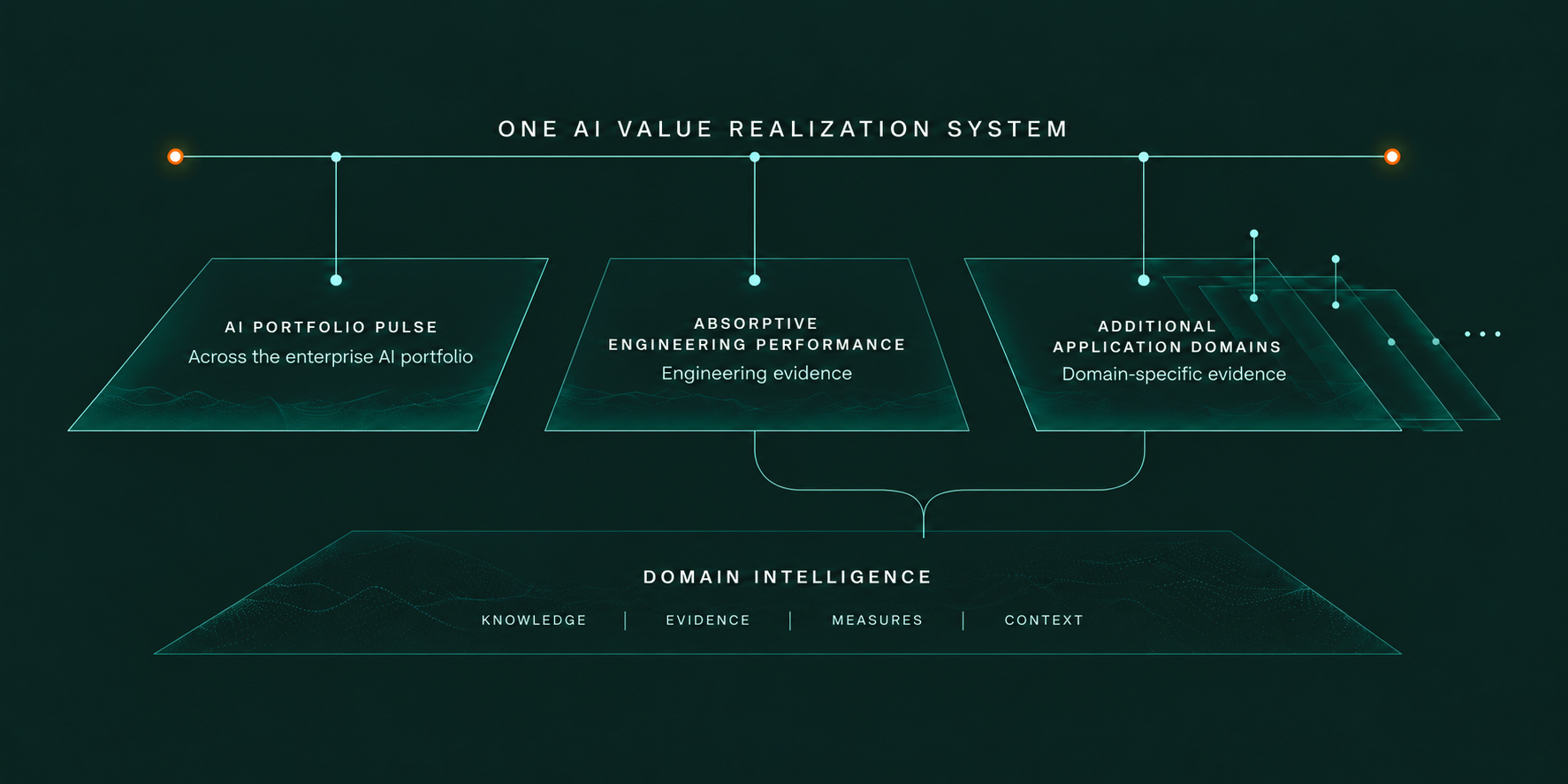
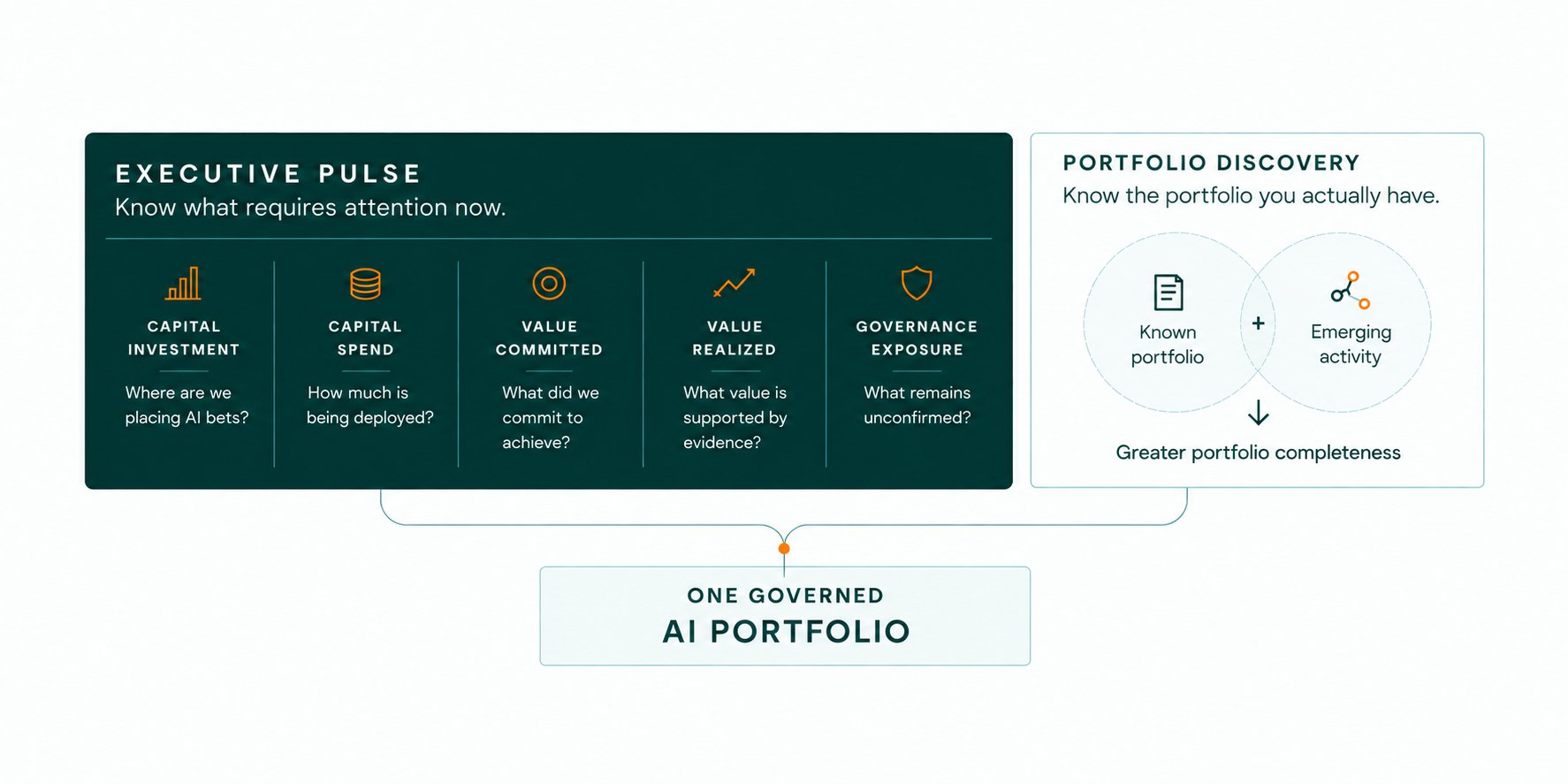
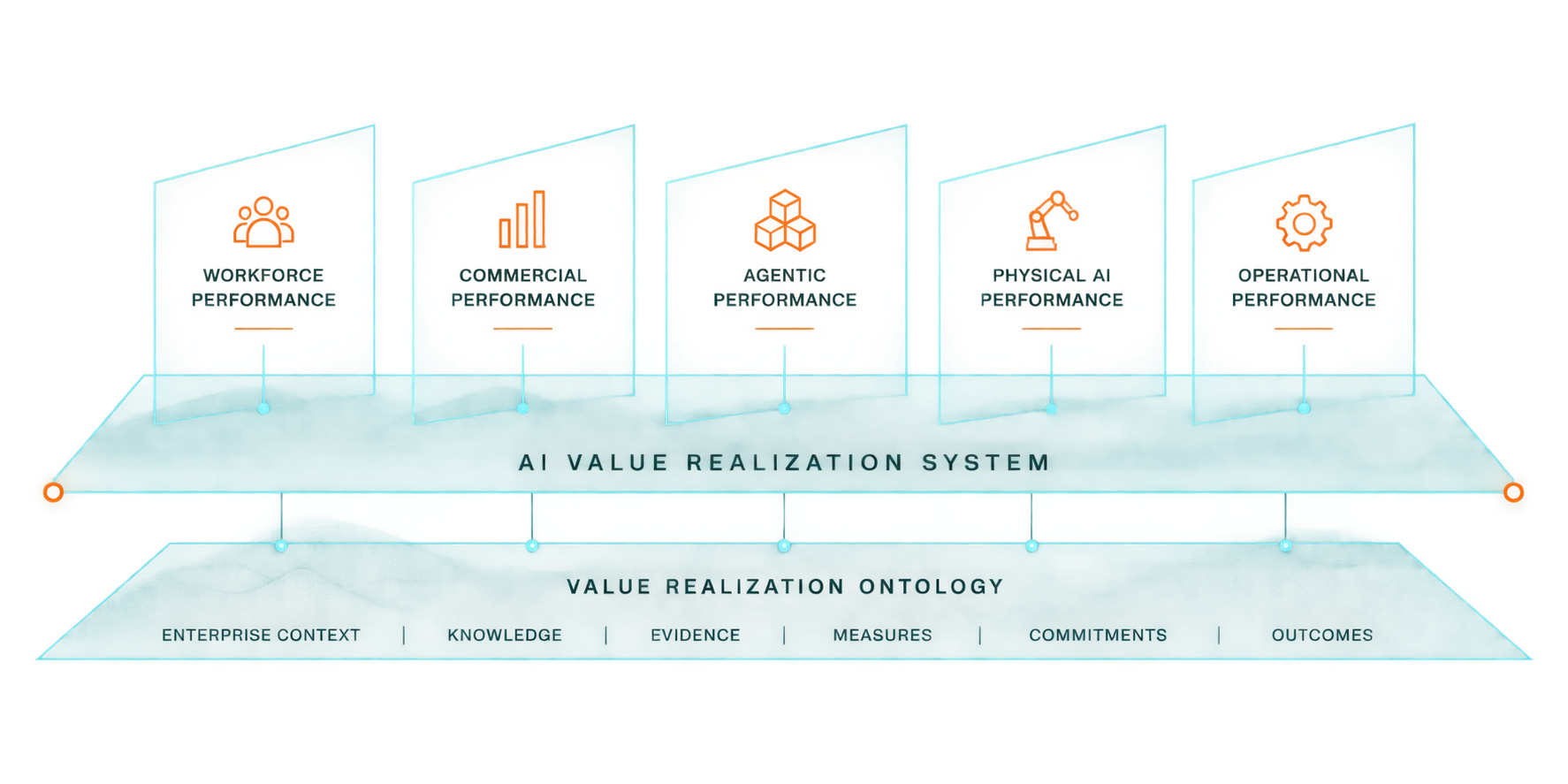
Across all four archetypes, the system establishes the full AI portfolio, declared and undeclared, and anchors every initiative to its commitment record.
Archetype 01
Engineering Performance
AI-Assisted Developer Productivity
What This Is

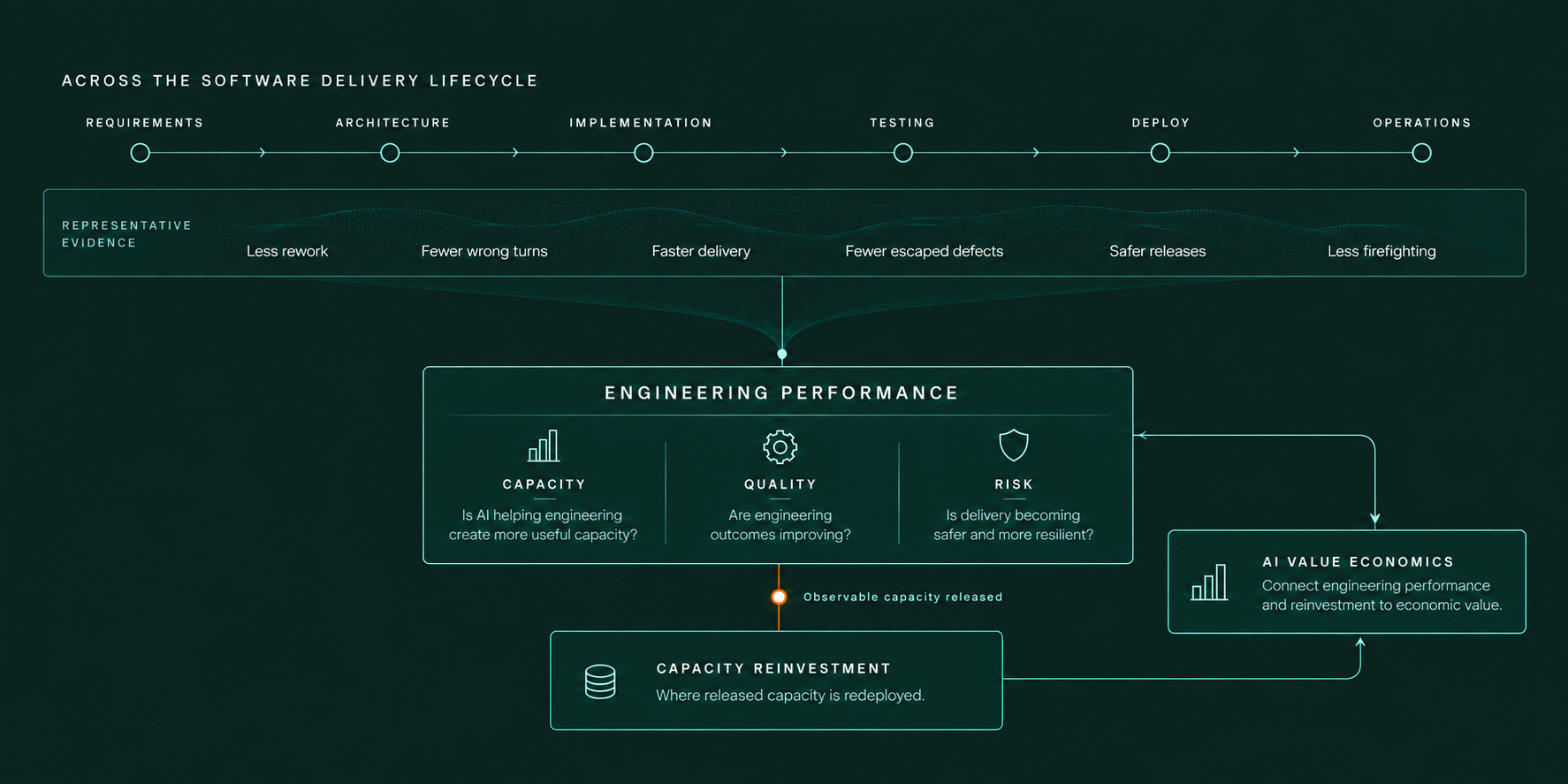
Engineering organizations deploy AI coding assistants expecting local productivity gains to become measurable enterprise engineering capacity. The acceleration is real. The conversion routinely breaks at scale.

Delivery gains are absorbed by workflow bottlenecks, review friction, supervision overhead, coordination drag, and governance gaps before committed outcomes are realized.

When engineering acceleration converts successfully, organizations achieve faster delivery, higher throughput, and sustained enterprise capacity. Not merely increased developer activity.

Absorptive governs where engineering acceleration disappears before becoming committed enterprise capacity.

AI Commitment Record

The ACR establishes engineering capacity commitments, realization thresholds, supervision boundaries, and evidence requirements before AI-assisted engineering workflows enter production.

It defines the committed enterprise outcome, the signals that will evidence realization, the thresholds that govern intervention, and the operational boundaries under which engineering acceleration is deployed.

Deployment coverage, workflow milestones, operational thresholds, and governance controls are declared before acceleration claims are made. Not reconstructed after productivity activity is observed.

Five-Layer Realization Chain Powered by Absorptive Intelligence
01
Instrumentation / Visibility

Confirms AI-assisted tools are generating commitment-anchored evidence. Maps DevEx, DORA, and AI platform telemetry against declared engineering commitments.

02
Production / Visibility

Confirms AI-generated output is entering the production workflow, traceable to source, and yielding output proportionate to tokens consumed.

03
Workflow / Attribution

Identifies where AI-generated capacity is consumed by conversion friction, review burden, supervision drag, and rework before reaching declared outcomes.

04
Capacity Unlock / Decision

Determines how much engineering capacity is becoming available, financially bounded and governance-honest, against what was declared before deployment.

05
Efficiency / Decision

Determines whether AI investment is converting efficiently over time and forecasts when governance exposure closes.

Signals Absorptive continuously evaluates signals across engineering, workflow, governance, and financial systems.
Enterprise Outcomes
Enterprise Outcome Absorptive Evidences
Capacity Unlock Evidences whether AI-assisted engineering acceleration converts into committed enterprise capacity, not merely increased activity.
Faster Software Delivery Evidences delivery improvement against committed enterprise targets, not isolated local gains.
Higher Engineering Throughput Evidences sustained throughput improvement attributable to AI-assisted engineering workflows.
Reduced Review Friction Identifies where review and supervision burden declines, and where coordination overhead reappears elsewhere in the workflow.
Stable Operations Validates that delivery acceleration maintains committed operational stability thresholds.
AI coding assistants accelerate developers.
Absorptive governs whether that acceleration becomes committed enterprise engineering capacity.
Archetype 02
Workforce Productivity
AI-Augmented Workforce Performance
What This Is

Organizations deploy predictive, generative, and agentic AI across professional and operational workforce populations expecting output gains to become measurable enterprise capacity. The performance signal is real. The conversion routinely breaks at scale.

Performance gains concentrate among early adopters while supervision overhead, override friction, coordination drag, and compliance burden suppress realization across the broader workforce.

When performance gains convert across the full population, organizations achieve measurable capacity increase, faster decisions, and lower supervision burden. Not merely higher adoption rates.

Absorptive governs where performance gains disappear before becoming committed enterprise capacity.

AI Commitment Record

The ACR establishes workforce capacity commitments, realization thresholds, supervision boundaries, override policies, and evidence requirements before AI-augmented workflows are deployed across the operating population.

It defines the committed enterprise outcome, the population segments included in realization measurement, the signals that evidence workforce absorption, and the intervention thresholds that govern deployment.

Adoption coverage, supervision policies, operational thresholds, and governance controls are declared before augmentation claims are made. Not reconstructed after isolated productivity gains are observed.

Five-Layer Realization Chain Powered by Absorptive Intelligence
01
Instrumentation / Visibility

Confirms AI-augmented tools are generating commitment-anchored evidence. Maps workforce optimization, AI platform, and compliance telemetry against declared commitments.

02
Workflow Entry / Visibility

Confirms AI-assisted outputs are entering the workforce workflow and influencing decisions across all AI modalities. Distinguishes genuine integration from surface adoption.

03
Workflow / Attribution

Identifies where AI-augmented capacity is consumed by supervision overhead, override review, and compliance drag before reaching declared outcomes.

04
Capacity Unlock / Decision

Determines how much workforce capacity is becoming available, financially bounded and governance-honest, against what was declared before deployment.

05
Efficiency / Decision

Determines whether AI investment is converting efficiently across the full workforce population and forecasts when governance exposure closes.

Signals Absorptive continuously evaluates signals across AI platforms, workforce engagement, compliance, operational, and financial systems.
Enterprise Outcomes
Enterprise Outcome Absorptive Evidences
Capacity Unlock Evidences workforce capacity realization across the full operating population, not isolated early-adopter segments.
Higher Workforce Throughput Evidences throughput improvement materializing at population scale, not concentrated within high-engagement cohorts.
Faster Decision Throughput Evidences decision quality and cycle-time improvement against committed operational thresholds.
Reduced Supervision Friction Identifies where supervision burden declines and where override concentration masks broader workforce stagnation.
Stable Quality Validates that workforce acceleration remains compliant with declared operational and governance thresholds.
AI systems augment workforce decisions.
Absorptive governs whether that augmentation becomes committed enterprise capacity.
Archetype 03
Agentic Enterprise
Agentic Enterprise Operations
What This Is

Organizations deploy autonomous and multi-agent systems expecting operational workflows to execute with reduced human intervention and higher enterprise responsiveness. The autonomy is real. The governance conversion routinely breaks at scale.

Autonomy gains are absorbed by undeclared agent components, cascade failures across downstream processes, and rising supervision burden as exception volumes compound.

When autonomous pipelines deliver as committed, organizations achieve cycle time compression, reduced human intervention, and sustained operational throughput. Not merely automation activity.

Absorptive governs where autonomous execution disappears before becoming committed operational throughput.

AI Commitment Record

The ACR establishes autonomous operating boundaries, delegation authority, supervision thresholds, intervention policies, recoverability requirements, and realization evidence before agentic systems execute operational workflows.

It defines which operational decisions may be delegated, which actions require human intervention, which signals evidence stable autonomous execution, and which thresholds trigger supervision escalation or operational rollback.

Delegation boundaries, supervision thresholds, intervention policies, and governance controls are declared before agents execute. Not reconstructed after autonomous activity is observed.

Five-Layer Realization Chain Powered by Absorptive Intelligence
01
Instrumentation / Visibility

Confirms multi-agent pipelines are generating commitment-anchored evidence. Maps runtime traces, MCP gateway logs, and orchestration telemetry against the declared agent architecture.

02
Execution / Visibility

Confirms agents are completing tasks within declared scope, tool boundaries, and approval thresholds. Distinguishes governed autonomous execution from ungoverned runtime drift.

03
Pipeline / Attribution

Identifies where autonomous throughput is consumed by cascade failures, exception escalation, and supervision overhead. A single failing agent propagates across downstream processes.

04
Throughput Unlock / Decision

Determines how much operational throughput is being autonomously delivered, financially bounded and governance-honest, against what was declared before deployment.

05
Efficiency / Decision

Determines whether autonomous efficiency is improving across the pipeline over time and forecasts when governance exposure closes before intervention latency compounds.

Signals Absorptive continuously evaluates signals across agentic runtime, authorization logs, compliance, and enterprise systems.
Enterprise Outcomes
Enterprise Outcome Absorptive Evidences
Operational Throughput Evidences autonomous completion rates sustaining committed operational throughput targets.
Cycle Time Compression Evidences cycle-time reduction attributable to autonomous workflow execution.
Exception Containment Tracks exception propagation and escalation rates against committed governance thresholds.
Supervision Reduction Identifies where supervision burden declines and where cascade failures compound operational overhead.
Architecture Integrity Validates runtime architecture against declared operational commitments. No undeclared agents. No ungoverned tool scope.
Agentic systems automate enterprise operations.
Absorptive governs whether that automation delivers committed operational throughput.
Archetype 04
Operational Excellence
AI-Embedded Operational Excellence
What This Is

Organizations embed predictive models, ML-driven scoring systems, and AI-powered decision engines into operational processes expecting continuous automated improvement to deliver committed business outcomes at scale. The model performs at deployment. The commitment erodes over time.

Operational AI systems accumulate drift, data quality degradation, and process integration gaps silently. Committed operational value declines without triggering intervention until the exposure is material.

When operational AI delivers as committed, organizations achieve sustained process efficiency, lower cost per decision, and consistent quality improvement. Not merely model deployment activity.

Absorptive governs whether operational AI continues to deliver committed outcomes or silently accumulates governance exposure.

AI Commitment Record

The ACR commits to sustained operational value outcomes against declared performance thresholds, not deployment-time benchmarks.

It establishes operational AI performance governance, data quality baselines, adoption telemetry, process integration milestones, and intervention triggers before the first operational decision is influenced.

Performance thresholds, data quality standards, transition governance for process integration, and intervention latency boundaries are declared before deployment. Not revised after operational drift accumulates.

Five-Layer Realization Chain Powered by Absorptive Intelligence
01
Instrumentation / Visibility

Confirms operational AI systems are generating commitment-anchored evidence. Maps model telemetry, data pipeline health, and operational system signals against declared performance commitments.

02
Operational Decisioning / Visibility

Confirms AI-driven operational decisions are performing within declared accuracy, reliability, and governance thresholds. Distinguishes sustained performance from deployment-time results.

03
Process / Attribution

Identifies where AI performance degradation, data quality failure, or integration gaps translate into operational outcome erosion. The point where committed value begins declining.

04
Value Realization / Decision

Determines how much committed operational value is still being delivered, financially bounded and governance-honest, against what was declared before deployment.

05
Efficiency / Decision

Determines whether operational AI efficiency and value conversion are improving over time and forecasts when governance exposure closes before intervention latency compounds.

Signals Absorptive continuously evaluates signals across model performance, data quality, operational process, risk, and compliance systems.
Enterprise Outcomes
Enterprise Outcome Absorptive Evidences
Process Efficiency Evidences process efficiency gains sustained against committed targets as operational AI evolves.
Cost Reduction Evidences cost reduction as attributable to operational AI performance against declared baselines.
Quality Improvement Tracks whether quality improvements are sustained or eroding as operational decision accuracy drifts from committed thresholds.
Risk Reduction Validates risk detection rates against committed operational thresholds and identifies where degradation begins to emerge.
Compliance Consistency Evidences compliance outcomes against declared standards as operational AI behaviour evolves.
AI models optimize enterprise operations.
Absorptive governs whether that optimization continues to deliver committed operational value.
Which Archetype Maps to Yours?

If one of these matches a portfolio you're trying to govern, let's discuss it.

Conversations are exploratory. We discuss your portfolio, your governance question, and whether an engagement makes sense.

Get in touch