The System

How Absorptive
Intelligence works.

Reading across signals against commitments to produce evidence-based decisions.

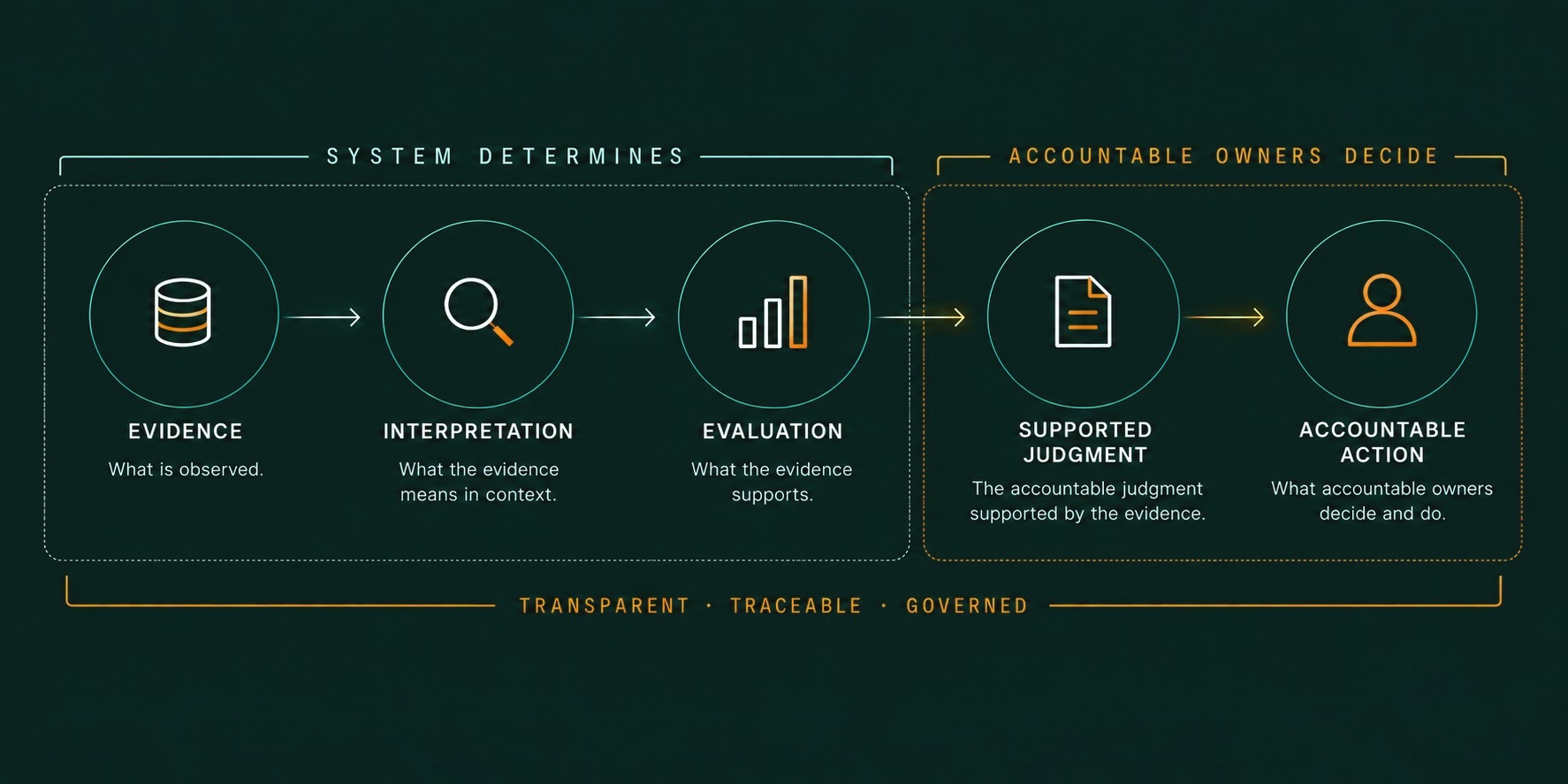
Activity does not become evidence by itself. Adoption does not become attribution by itself. Absorptive Intelligence instruments the gap between usage and realized value, interpreting every signal against an explicit commitment made before the work began.

I · The Architecture

Signals on the left. Decisions on the right. The commitment in the middle.

Enterprises already generate the signals that explain whether AI investment is working. Source control, workflow systems, observability platforms, agent runtime traces, financial systems, usage telemetry, escalation logs. The activity is not invisible. What is missing is the commitment to interpret those signals against.

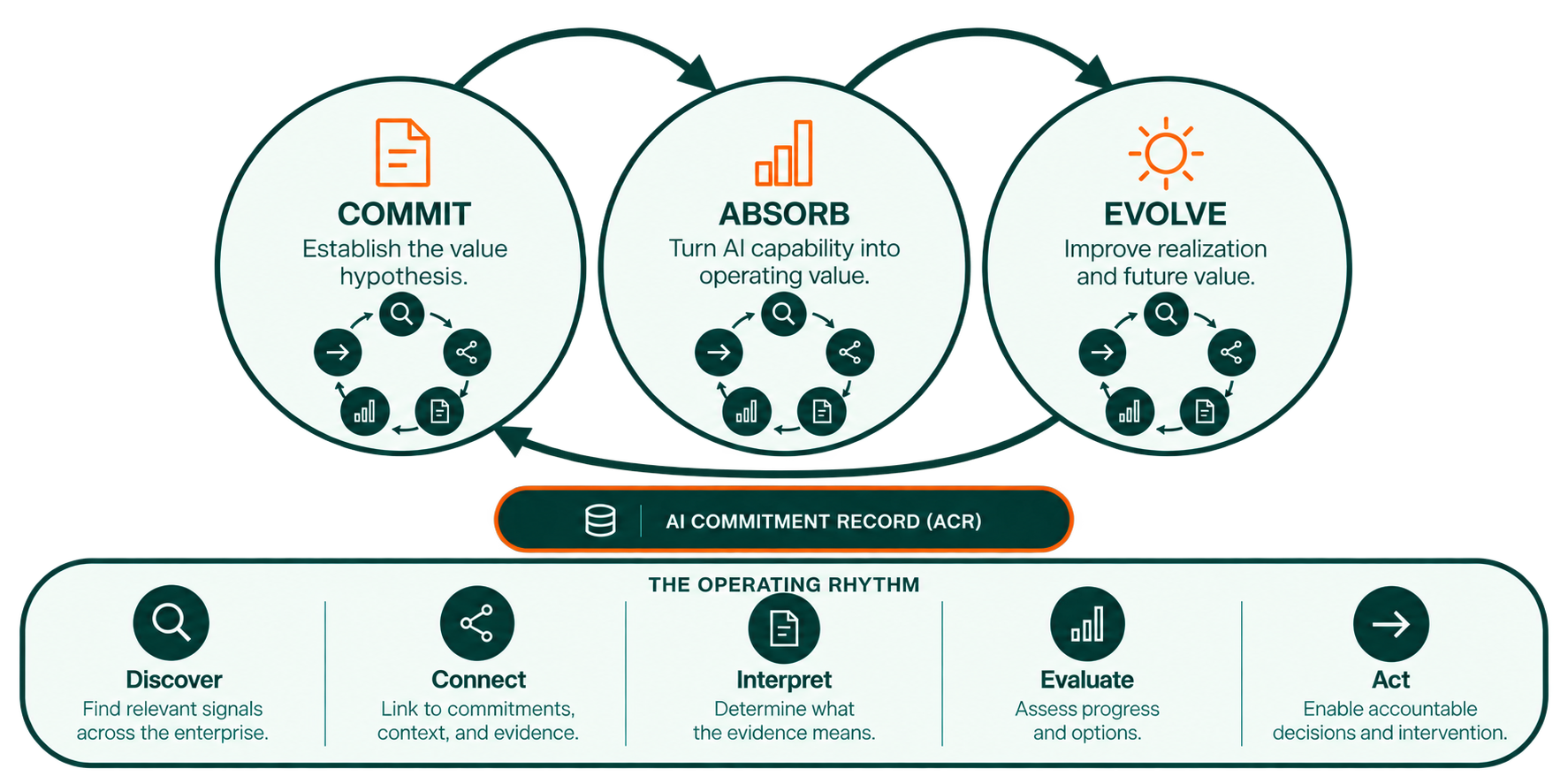
Absorptive Intelligence sits between the raw signals and the decisions they should drive. The AI Commitment Record anchors interpretation. Five capabilities operate continuously around it: Discover, Connect, Interpret, Evaluate, and Act.

Enterprise AI Activity
Compute Economics
Cost · Tokens · GPU utilization · Latency
Model and Decision Integrity
Drift · Accuracy · Deployments
Engineering and Workflow Activity
Commits · Pull requests · Cycle time
Workforce Adoption and Supervision
Active users · Override rate · Interventions
Outcomes and Realization
Targets · Baselines · Actuals
Evidence Lineage and Integrity
Lineage · Freshness · Audit trail
Agentic Execution and Autonomy
Agent traces · Tool calls · Authorizations
Commitments Anchor Interpretation
01 Discover
02 Connect
Absorptive Intelligence
AI Commitment Record (ACR)
03 Interpret
04 Evaluate
05 Act
Three Things Absorptive Produces
Evidence, Not Activity
Signal patterns interpreted against committed outcomes.
Attribution, Not Assertion
Value traced to accountable initiatives against measurable baselines.
Decisions, Not Dashboards
Governance actions with quantified capital at risk and intervention windows.
Absorptive Intelligence converts enterprise AI activity into evidence, attribution, and decisions.

Signals enter the system through connectors that read directly from source systems already running in the enterprise, source control, workflow systems, model registries, agent runtimes, financial systems. Where a signal category exists but no connector is in place, it appears as an addressable instrumentation gap, not as an unknown.

II · The AI Commitment Record

The contract that anchors everything else.

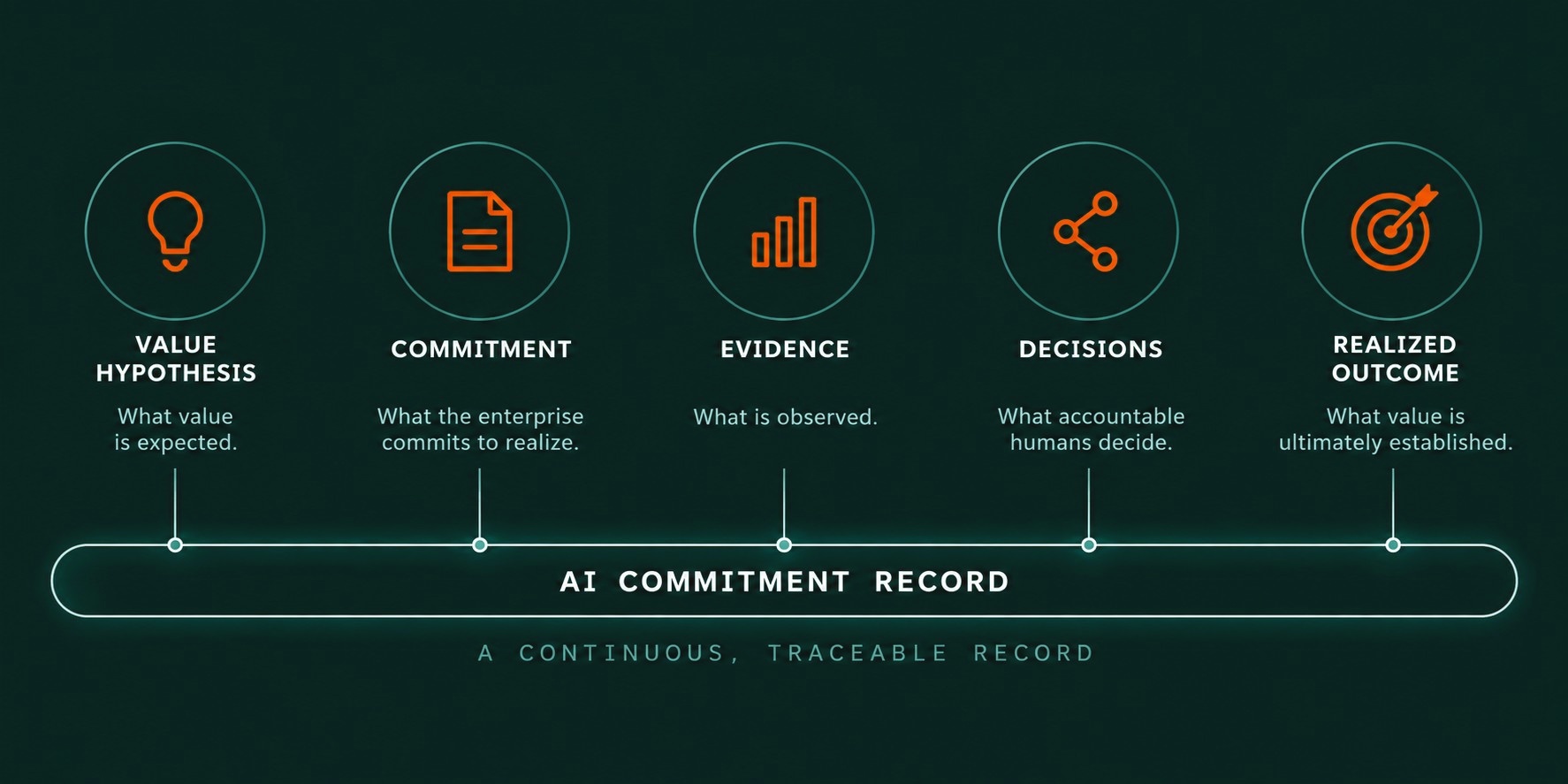
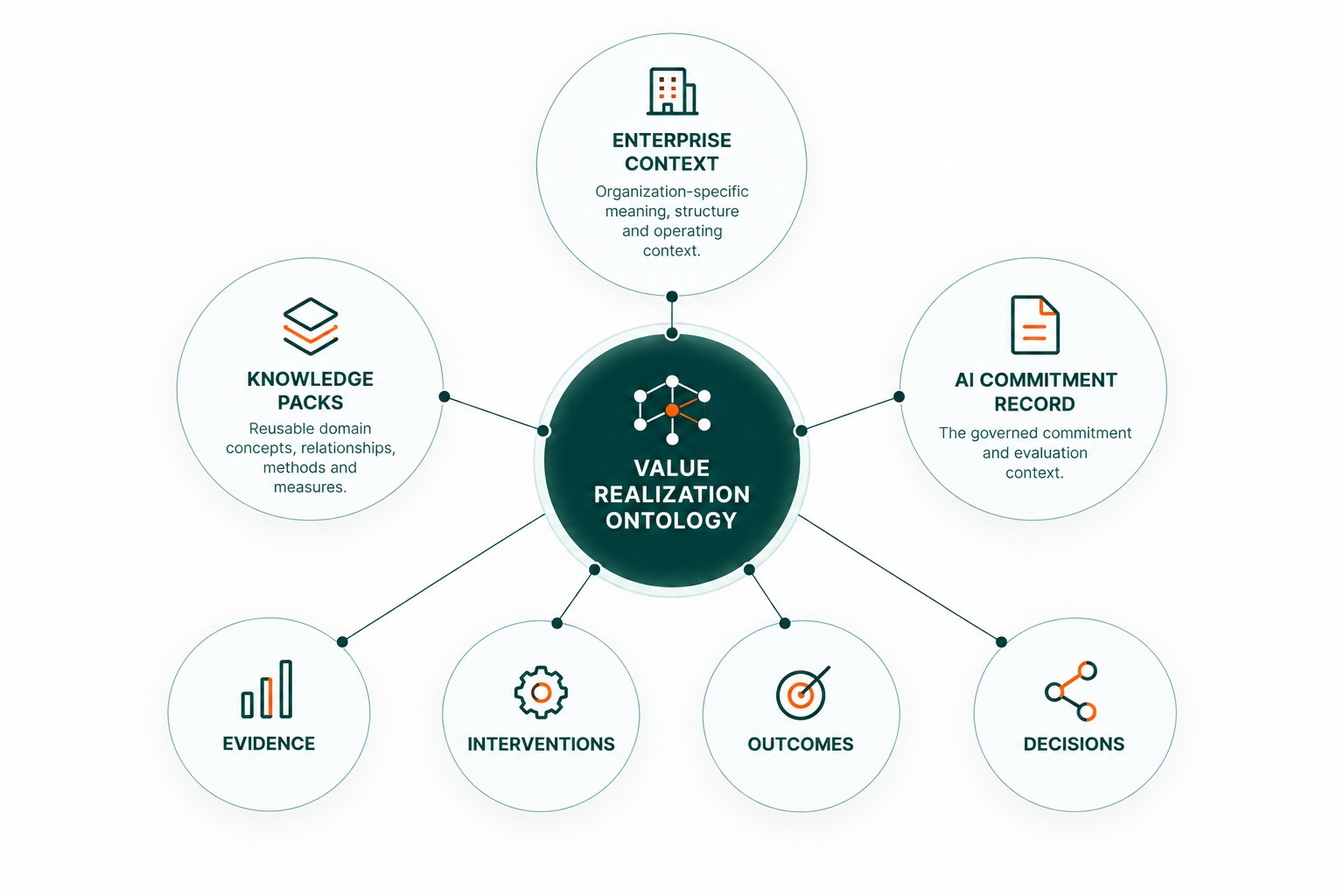
The ACR is the central artifact of the system. Established at the moment of capital commitment, it records what the initiative is committing to, who is accountable, what value it expects to produce, and how that value will be defended, before the baseline begins to shift.

The ACR is not a form. It is a contract between the initiative and the portfolio.

For initiatives already in flight, the system reconstructs an ACR from available signals. For new initiatives, the ACR is authored at commitment and progressively populated as the initiative passes through the four gates. ACRs are continuously updated as new signals arrive and gate evaluations advance.

The ACR commits an owner, a capital plan, a target value outcome, and a measurement architecture that defines what success looks like, before the baseline begins to shift. It also commits the governance terms under which the initiative will be supervised: authorization scope for agentic systems, supervision protocols, and knowledge retention.

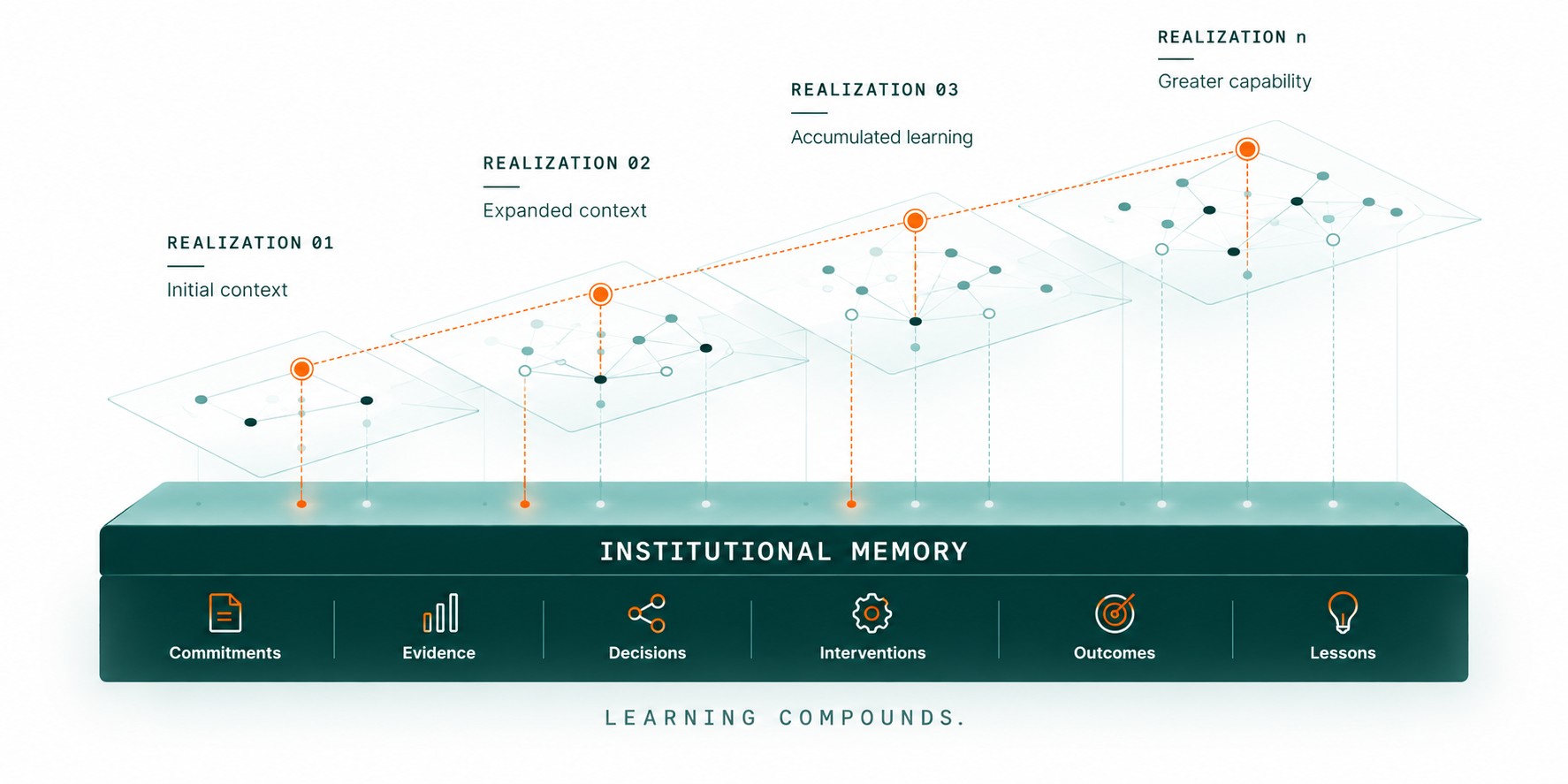
The architecture is intentionally comprehensive. Every signal that arrives later is evaluated against the commitment recorded here. Without the commitment, there is nothing to interpret signals against; the chain of evidence cannot be assembled.

As the initiative evolves, changes to the original commitment are explicit and visible. The system keeps the history of what was committed, what changed, and why.

III · The Four Gates

From instrument the system, to value realized.

Every initiative progresses through four gates. Each gate evaluates a distinct organizational event: technical wiring, human adoption, operational absorption, business realization. Evidence at each gate is built from signals committed in the ACR.

G1
Instrumentation
Is the AI system wired in correctly?
Evidence that the system is technically present, baselines are captured, and signals can be observed.
G2
Adoption
Is it being used by the people it was built for?
Evidence that the system is in active use, with the override patterns and trust signals that use produces.
G3
Absorption
Is use converting into operational capacity?
Evidence that the activity is producing the operational changes the initiative was commissioned to produce.
G4
Realization
Did the committed enterprise outcome materialize?
Evidence that the committed value is in place, attributable to the initiative against the pre-deployment baseline.
Passing
Watch
Failing

Each gate carries one of three evidence states. A gate that holds in Watch for too long is a signal in itself. A gate that fails inherits downstream: G2 failing propagates to G3, G4. Gates are earned, not skipped.

IV · Attribution

From commitment to causal confidence.

The ACR sets more than what the initiative commits to deliver. It declares how the resulting value will be defended. That declaration determines the strongest claim the system can support, set at inception, before the baseline shifts.

The maximum claim a system can defend is set in the ACR at inception, stronger claims require commitment design, not better statistics later. Gates are earned in sequence; skipped gates collapse the defensible claim.

Absorptive supports tiered attribution. The right tier depends on the decision the evidence has to support. A program owner reallocating budget across initiatives has a different evidence requirement than a CFO defending the AI line-item to the board, or a regulator reviewing an autonomous system. The system makes the tier explicit, so the evidence arrives in the form the decision will demand.

V · Simulation & the Forward Read

What-if before capital is committed or redirected.

The four gates and the attribution framework are retrospective and continuous. Simulation is the prospective layer. Before capital is committed to a new initiative, before a stalled program is redirected, before an agentic system is authorized for production, the system models the decision against the existing signal chain and historical portfolio patterns.

Simulation operates at three levels, portfolio, program, and initiative, with two specialized surfaces: a Process Twin for workflow shadow-testing and an Agentic Simulation Lab for safe agent sandboxing. Decisions propagate bidirectionally across levels.
Macro
Portfolio
CFO · Capital allocator

What-if capital reallocation across the full AI portfolio. Forward trajectory of the portfolio under different investment mixes. Intervention impact before budget is committed or redirected.

Capital reallocation scenarios
Forward portfolio trajectory
Portfolio risk distribution
Meso
Program
CDAO · Program owner

Intervention modelling for stalled initiatives before acting. Change management, scope, or resourcing changes evaluated against the existing signal chain.

Intervention scenarios
Gate recovery likelihood
Stall diagnosis
Micro
Initiative · Process Twin
AI Lead · Initiative owner

Digital replica of the target workflow runs in parallel with production in shadow mode, no live actions. Validates decision quality, latency, and authorization patterns before deployment commitment.

Process Twin
Parallel execution
Pre-deployment validation
Lab
Agentic Simulation
Standalone surface

Constrained sandbox for safe pre-deployment testing of agentic systems. Authorization scope, escalation triggers, and decision boundaries are exercised against real process conditions before any production commitment.

Authorization scope validation
Escalation calibration
Decision quality testing
The Forward Read · Absorptive Capacity Index
The portfolio's direction of travel.

Simulation is the prospective view at the initiative and program level. The Absorptive Capacity Index is the prospective view at the portfolio level. It does not measure individual initiative health. It measures the enterprise's capability to absorb AI investment as a whole, five dimensions that move as the corpus deepens.

01
Signal Coverage
02
Gate Velocity
03
Attribution Quality
04
Investment Alignment
05
Adoption Depth

The index is intentionally not a real-time operational metric. On day one, the system produces the ACR coverage map and the gate evidence. The ACI becomes meaningful as the corpus deepens across initiatives and time. Its value compounds.

Walk Through The System

If this maps to a portfolio you're trying to govern, let's discuss it.

Conversations are exploratory. We discuss your portfolio, your governance question, and whether an engagement makes sense.

Get in touch